

Understanding Online Weight Management: Why Patient Safety Must Come Before Marketing
This article was written by Sally - Operations Manager.
You can contact me directly at sally@we-are-aster.co.uk

Understanding weight management from the point of view of the patient is the first step for anyone providing a weight management service. It is important to understand why someone may need help with their weight, what risks may affect them, and most importantly, how to keep them safe.
Seeing why people choose a provider was important when we built Aster. We wanted to create something people genuinely need: a service that offers clinical care, honest information and ongoing support, rather than a process that feels rushed or sales-led.
To better understand the patient experience, I signed up for two leading online weight management providers. This was not done to identify or criticise individual brands. It was done to understand what patients may see, receive and feel when they start exploring online treatment options.
It did not take long for us to feel concerned about some wider patterns across the online weight management market, including:
pressure-based marketing
medicine-led or treatment-led messaging
pricing and offers appearing early in the journey
encouragement to choose or continue towards treatment before a meaningful clinical consultation or review
a lack of clarity around what is clinical information and what is promotional marketing
This post is based on personal experience and does not identify individual providers. The purpose is to make people aware of red flags in the online weight management industry, the legal and regulatory protections around prescription medicines, and why personal and clinical safety should be at the centre of any decision to start treatment.
The law: Prescription medicines are not ordinary consumer products

The law in the UK is strict on Prescription Only Medicines (POMs), yet patients may still come across marketing that raises compliance concerns.
In the UK, prescription-only medicines are treated differently from ordinary products for a reason. They can only be prescribed by an appropriately qualified prescriber after a clinical decision has been made. They are not suitable for everyone, may cause side effects, may interact with other medicines, and may require monitoring.
The law in the UK (Human Medicines Regulations 2012) restricts the advertising of prescription-only medicines to the public. The MHRA’s Blue Guide explains how advertising and promotion of medicines should be approached in the UK, and the core principle is clear: prescription-only medicines should not be promoted to the public as products to request, buy or choose.
The ASA and CAP Code also make this clear. Weight management services can advertise a consultation or clinical service, but they must not advertise prescription-only medicines to the public or create an impression that the likely outcome of the consultation is a specific prescription treatment.
This matters because medical weight management is a clinical pathway. It should start with assessment, not product selection.
This means any communication about a prescription only medicine should be factual, clinical and impartial, not meant to invite someone to ‘buy’ or ‘receive’ a medicine or allude to the idea they will not need a consultation.
What safe prescribing is meant to involve
Prescribing is not simply choosing a medicine from a list.
In the UK, prescribers are trained and regulated. Doctors and dentists prescribe as part of their professional registration with the GMC and GDC respectively. Other healthcare professionals, including pharmacists (GPhC), nurses (NMC) and some allied health professionals, must complete approved prescribing training and be appropriately annotated or registered as prescribers with their professional regulator. You can check someone’s prescribing annotation with the GPhC by searching them here.
For pharmacist independent prescribers, this means completing a GPhC-accredited independent prescribing programme and meeting defined learning outcomes before their prescriber annotation can be added to the register. These programmes focus on person-centred care, professionalism, clinical knowledge, decision-making and collaboration.
Across the UK, prescribers are expected to follow recognised prescribing principles. The Royal Pharmaceutical Society’s Competency Framework for all Prescribers is used across professions and sets out the behaviours expected of safe and effective prescribers.
Prescribers are taught to assess the patient, consider the diagnosis, review relevant medical history, consider risks and benefits, discuss options, make shared decisions, prescribe only when appropriate, monitor outcomes, and know when not to prescribe.
That final point is important.
A safe prescriber must be able to say no.
If you provide information to a service and are immediately sent to check-out without first:
Having your data reviewed by a clinician
Having your identity confirmed
Speaking to a clinician
Then the service being provided is not working within current published guidelines, which are there to protect your health.
Weight management requires extra care
Weight management treatment can be valuable for the right person, but it can also carry risks if supplied without proper checks.
The GPhC has strengthened expectations for online pharmacies providing weight management medicines. Prescribers should not rely on questionnaire answers alone. For weight management medicines, the person’s weight, height and/or BMI should be independently verified, for example through video consultation, in-person checks, clinical records, or another healthcare provider.
This is not a small administrative detail. It exists to protect people.
A person may enter an incorrect weight or height, misunderstand eligibility, omit relevant medical history, or be at risk because of an eating disorder, pregnancy, breastfeeding, alcohol use, mental health concerns, previous side effects, pancreatitis, gallbladder disease, medicines interactions or other factors.
A responsible provider needs systems that allow these risks to be identified and managed. That includes proper consultation, appropriate records, clear refusal criteria, ongoing monitoring, and a willingness to pause or stop treatment when needed.
Where marketing becomes a concern
The issue we noticed was how quickly some patient journeys can appear to move from enquiry into promotion. Below are some texts I received as someone deemed eligible for treatment, but who had not proceeded with payment. Notice the times of day they were received, the naming of medicines, and the price incentives:
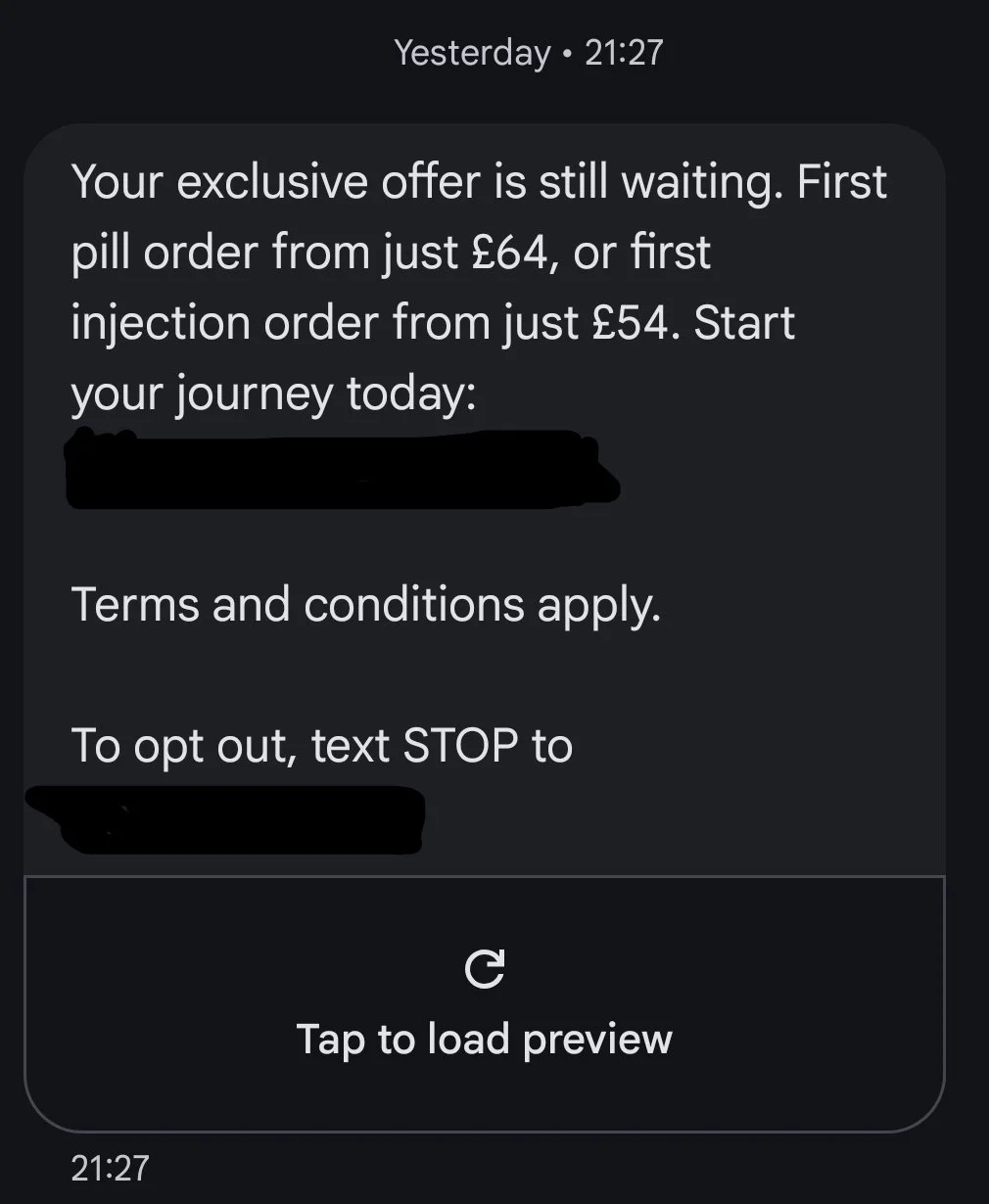
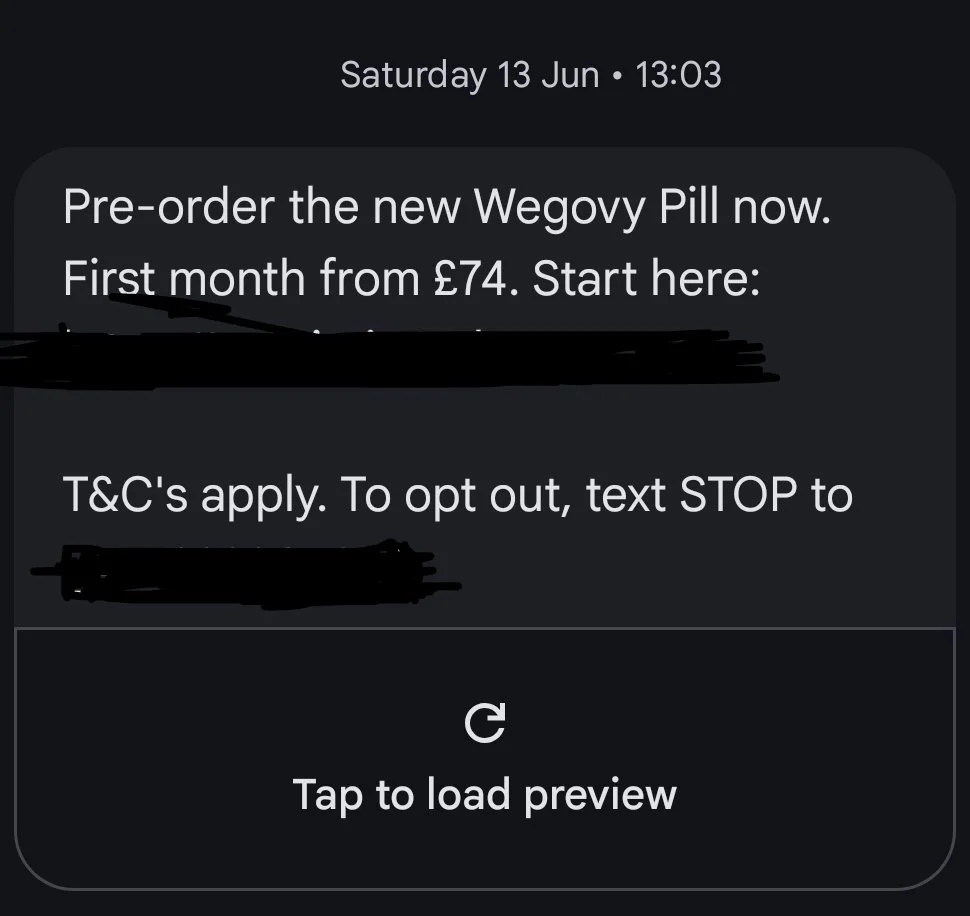
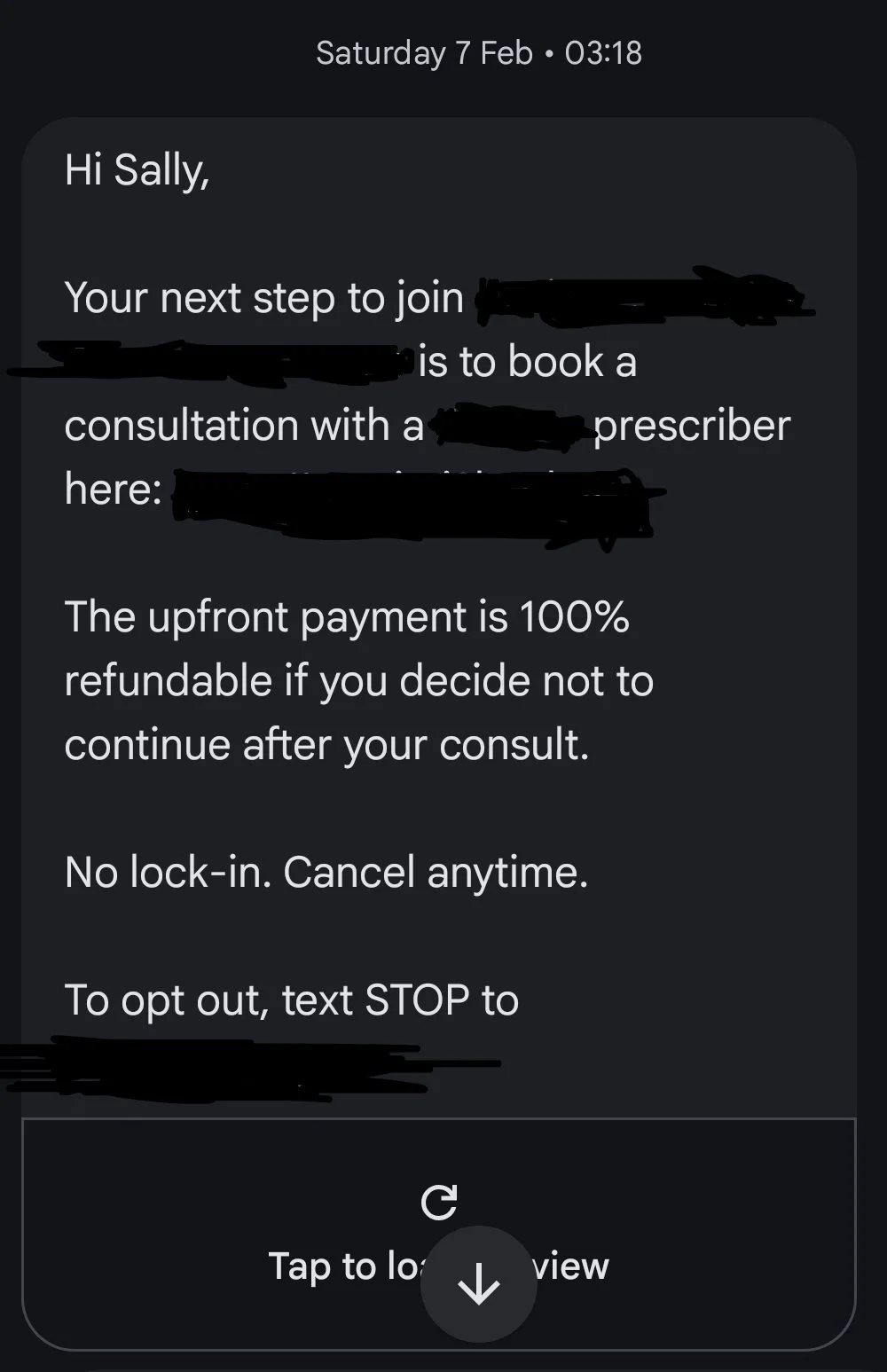
Good communication is helpful. Patients should know what happens next, how to book, what information is needed, and how to ask questions. But there is a difference between supportive communication and pressure-based marketing.
When messages focus heavily on treatment availability, offers, pricing, urgency or prompts to continue before a proper clinical review, the experience can start to feel commercially led rather than clinically led.
That is a problem in medical weight management because the patient should not be encouraged to think:
“Which treatment do I want to buy?”
They should be supported to ask:
“Is treatment clinically appropriate for me?”
“Have my risks been properly assessed?”
“What are the benefits and side effects?”
“What monitoring will I receive?”
“What happens if I am not suitable?”
“What will this cost over time?”
These are healthcare questions. They cannot be answered properly by a discount, a countdown, or a late-night marketing message.
Why Aster is different
Aster was built around a different principle: clinical care first. We have all seen people who were not clinically safe to use weight loss medicines, being prescribed it by other services. It’s concerning that people who face serious risks (e.g. people with history of gallbladder issues, people with eating disorders and body dysmorphia, people who are of healthy weight or even underweight) may not be being assessed appropriately.
We do not want weight management to feel like a checkout process.
We do not use first-month offers to encourage people to start.
We do not lock patients into subscriptions. We do not guarantee treatment.
We do not want anyone to feel rushed into a medical decision.
Our process is designed around assessment, suitability, transparent pricing and ongoing support.
At Aster, being eligible to book an appointment does not mean treatment is guaranteed. It means a clinician can review your information properly and decide whether medical weight management may be suitable.
Prescription treatment is only considered after clinical review, and only if it is appropriate.
That may sound less exciting than “start today”.
But it is much more responsible.
Medical weight management should begin with care, not pressure, and we’re excited to continue building our service around those principles exactly.
If you use a service and you think they are not practicing safely, you can report them.
If you are concerned about advertising or marketing
If you have seen an advert, email, text message, social media post or website that appears to promote prescription-only medicines to the public, you can report this to the Advertising Standards Authority (ASA).
Examples may include medicine names, treatment-specific prices, “start now” wording, discount offers, urgency-based messaging, or images that appear to promote prescription weight management treatment.
Report to the ASA:
https://www.asa.org.uk/make-a-complaint.html
ASA guidance on prescription-only medicines:
https://www.asa.org.uk/advice-online/healthcare-prescription-only-medicine.html
ASA guidance on weight control and prescription-only medicines:
https://www.asa.org.uk/advice-online/weight-control-prescription-only-medicines.html
If you are concerned about medicines being promoted or sold illegally
The Medicines and Healthcare products Regulatory Agency (MHRA) regulates medicines and medical devices in the UK.
You can report concerns about misleading medicines advertising to the MHRA.
Report misleading medicines advertisements:
https://www.gov.uk/drug-safety-update/report-misleading-medicines-advertisements
You can also report a suspicious online seller of medicines or medical devices. This can include websites or online sellers you believe may be offering medicines illegally. Reports to this MHRA service can be made anonymously.
Report a suspicious online seller:
https://www.gov.uk/report-suspicious-online-medicine-seller
Check if a website is listed as “not recommended” by the MHRA:
https://www.gov.uk/check-suspicious-online-medicine-seller
If you are concerned about a pharmacy, pharmacist or pharmacy technician
If the service is provided by a registered pharmacy, or you are concerned about the conduct of a pharmacist or pharmacy technician, you can raise a concern with the General Pharmaceutical Council (GPhC).
Raise a concern with the GPhC:
https://www.pharmacyregulation.org/patients-and-public/reporting-concerns
Check whether a pharmacy is registered with the GPhC:
https://www.pharmacyregulation.org/registers/pharmacy
Check whether a pharmacist is registered with the GPhC:
https://www.pharmacyregulation.org/registers/pharmacist
If you received unwanted marketing texts, calls or emails
If you receive unwanted marketing texts, nuisance calls or spam messages, you can report them to the Information Commissioner’s Office (ICO). The ICO uses reports to help investigate and take action against nuisance marketing.
Report spam texts and nuisance calls to the ICO:
https://ico.org.uk/make-a-complaint/nuisance-calls-and-messages/spam-texts-and-nuisance-calls/
If you experienced side effects or harm from a medicine
If you think you have experienced a side effect or adverse reaction from a medicine, you can report this through the MHRA Yellow Card scheme.
You can report suspected side effects yourself, or on behalf of someone else with their permission.
Report a side effect through Yellow Card:
https://yellowcard.mhra.gov.uk/
If you are worried about your health, speak to a doctor, pharmacist or NHS 111. In an emergency, call 999.
If you are concerned about a doctor, nurse or other prescriber
If your concern is about an individual healthcare professional, the correct regulator depends on their profession.
For doctors, physician associates or anaesthesia associates:
General Medical Council
https://www.gmc-uk.org/concerns/raise-a-concern
For nurses, midwives or nursing associates:
Nursing and Midwifery Council
https://www.nmc.org.uk/concerns-nurses-midwives/raise-a-concern/
For pharmacists or pharmacy technicians:
General Pharmaceutical Council
https://www.pharmacyregulation.org/patients-and-public/reporting-concerns
If you are concerned about the wider healthcare service
You may also be able to share concerns with the healthcare regulator for the part of the UK where the service is registered.
England — Care Quality Commission:
https://www.cqc.org.uk/give-feedback-on-care
Scotland — Healthcare Improvement Scotland:
https://www.healthcareimprovementscotland.scot/inspections-reviews-and-regulation/regulation-of-independent-healthcare/information-for-the-public/making-a-complaint-about-independent-healthcare-services/
Wales — Healthcare Inspectorate Wales:
https://www.hiw.org.uk/provide-feedback-about-healthcare-service
Northern Ireland — Regulation and Quality Improvement Authority:
https://www.rqia.org.uk/contact/raise-a-concern-about-health-and-social-care-service/
What to keep as evidence
If you are reporting a concern, it can help to keep:
screenshots of adverts, emails, texts or website pages
dates and times messages were received
the website address or link
the name of the provider, if visible
copies of invoices, order confirmations or consultation messages
details of whether a clinical consultation happened before treatment was offered
details of any side effects or harm experienced
whether you tried to unsubscribe or ask the provider to stop contacting you
If you are worried that a medicine or service has caused harm, do not wait for a complaint outcome before seeking medical help.
Sources
GPhC: Online Pharmacies to Strengthen Safeguards to Prevent Unsafe Supply of Medicines
Explains strengthened safeguards for online pharmacies, including independent verification of weight, height and/or BMI before supplying weight-management medicines.
https://www.pharmacyregulation.org/about-us/news-and-updates/online-pharmacies-strengthen-safeguards-prevent-unsafe-supply-medicines
GPhC: Providing Weight Management Services — FAQs
Practical guidance for pharmacy owners, superintendent pharmacists, pharmacists and pharmacy technicians providing weight-management services.
https://www.pharmacyregulation.org/pharmacies/standards-and-guidance-registered-pharmacies/providing-weight-management-services-faqs
GPhC: Guidance for Registered Pharmacies Providing Pharmacy Services at a Distance, Including on the Internet
Guidance on safely providing pharmacy services online or at a distance.
https://assets.pharmacyregulation.org/files/2025-02/gphc-guidance-registered-pharmacies-providing-pharmacy-services-distance-february-2025.pdf
GPhC: Independent Prescriber Education and Training
Information on how pharmacists become independent prescribers, including accredited training and supervised learning in practice.
https://www.pharmacyregulation.org/students-and-trainees/pharmacist-education-and-training/independent-prescriber-education-and-training
GPhC: Standards for the Education and Training of Pharmacist Independent Prescribers
Standards setting out the knowledge, skills and behaviours pharmacist independent prescribers must demonstrate.
https://assets.pharmacyregulation.org/files/document/standards-for-the-education-and-training-of-pharmacist-independent-prescribers-october-2022.pdf
Royal Pharmaceutical Society: A Competency Framework for All Prescribers
A UK-wide prescribing framework describing what safe, effective and person-centred prescribing should involve.
https://www.rcpharm.org/professional-standards/a-competency-framework-for-all-prescribers/
Human Medicines Regulations 2012 — Regulation 284
Sets out the legal restriction on publishing advertisements likely to lead to the use of a prescription-only medicine.
https://www.legislation.gov.uk/uksi/2012/1916/regulation/284
MHRA Blue Guide: Advertising and Promoting Medicines
Official MHRA guidance on the advertising and promotion of medicines in the UK.
https://www.gov.uk/government/publications/blue-guide-advertising-and-promoting-medicines
GOV.UK: Advertise Your Medicines
Government guidance explaining that prescription-only medicines cannot be advertised to the general public.
https://www.gov.uk/guidance/advertise-your-medicines
ASA CAP Code — Section 12: Medicines, Medical Devices, Health-Related Products and Beauty Products
Includes rule 12.12, which states that prescription-only medicines or prescription-only medical treatments may not be advertised to the public.
https://www.asa.org.uk/type/non_broadcast/code_section/12.html
ASA Guidance: Prescription-Only Medicines and the Code
Explains how the advertising rules apply to prescription-only medicines.
https://www.asa.org.uk/news/prescription-for-compliance-poms-and-the-code.html
ASA Guidance: Weight Control — Prescription-Only Medicines
Specific guidance on advertising weight-management services involving prescription-only medicines.
https://www.asa.org.uk/advice-online/weight-control-prescription-only-medicines.html
ASA Guidance: Healthcare — Prescription-Only Medicines
Guidance on how prescription-only medicines may be referenced on websites, social media and other public-facing material.
https://www.asa.org.uk/advice-online/healthcare-prescription-only-medicine.html
GOV.UK / MHRA: Warning on Promoting Newly Licensed Prescription-Only Medicines and Unlicensed Medicines for Weight Management
Joint warning on the promotion of newly licensed and unlicensed medicines for weight management.
https://www.gov.uk/government/news/warning-on-promoting-newly-licensed-prescription-only-medicines-and-unlicensed-medicines-for-weight-management

This article was written by Sally
Operations Manager
Aster, Pharmacy Clinic Edinburgh & Arcadia Health Clinic
